
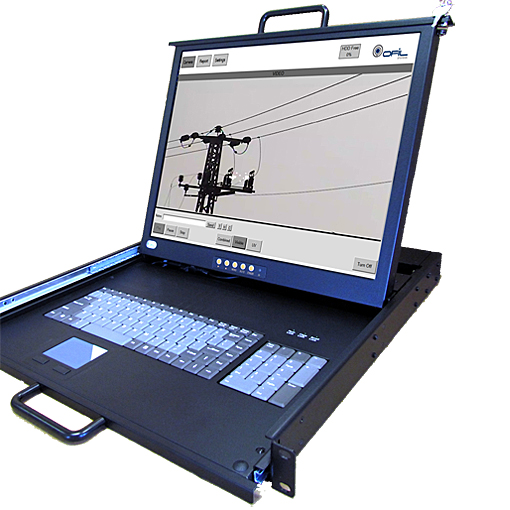
Description
As global transport demand grows, maintaining the integrity of railway infrastructures is crucial to avoiding power outages and service disruptions. Failures in overhead components account for a significant portion of railway electric issues. OFIL Systems meets these challenges with advanced monitoring solutions that enhance the safety, reliability, and efficiency of railway operations. Our technologies proactively detect and mitigate critical failures, ensuring smoother service and reducing downtime costs.
Overhead Lines
Overhead lines are essential for delivering power to railway systems but are susceptible to corona partial discharge (PD). This discharge, often caused by aging insulators, improper installation, or contamination, can result in equipment failure, costly downtime, and safety risks if not addressed
Solar-blind UV corona cameras can be seamlessly integrated on the roof of passenger or dedicated inspection trains, enabling continuous, on-the-move inspection of overhead lines. These cameras capture UV emissions associated with PD, and pinpoint the exact location of faults in insulators, conductors, and hardware. This real-time detection ensures reliable power delivery, predictive maintenance, and minimize long-term maintenance costs.
Traction Substations
Traction substations supply power to railway systems, converting electricity from the grid to the required voltage and current for train operation. They contain key components like transformers and switchgear, which are critical for ensuring reliable and efficient power delivery.
Solar-blind UV cameras provide a portable and user-friendly solution for inspecting traction substations. These handheld devices enable operators to perform real-time, on-site detection of UV emissions linked to corona partial discharge (PD). With high precision, these cameras pinpoint faults, allowing operators to identify and resolve issues efficiently. This approach supports predictive maintenance, enhances system reliability, and ensures consistent power delivery to railway systems while reducing long-term maintenance costs.
